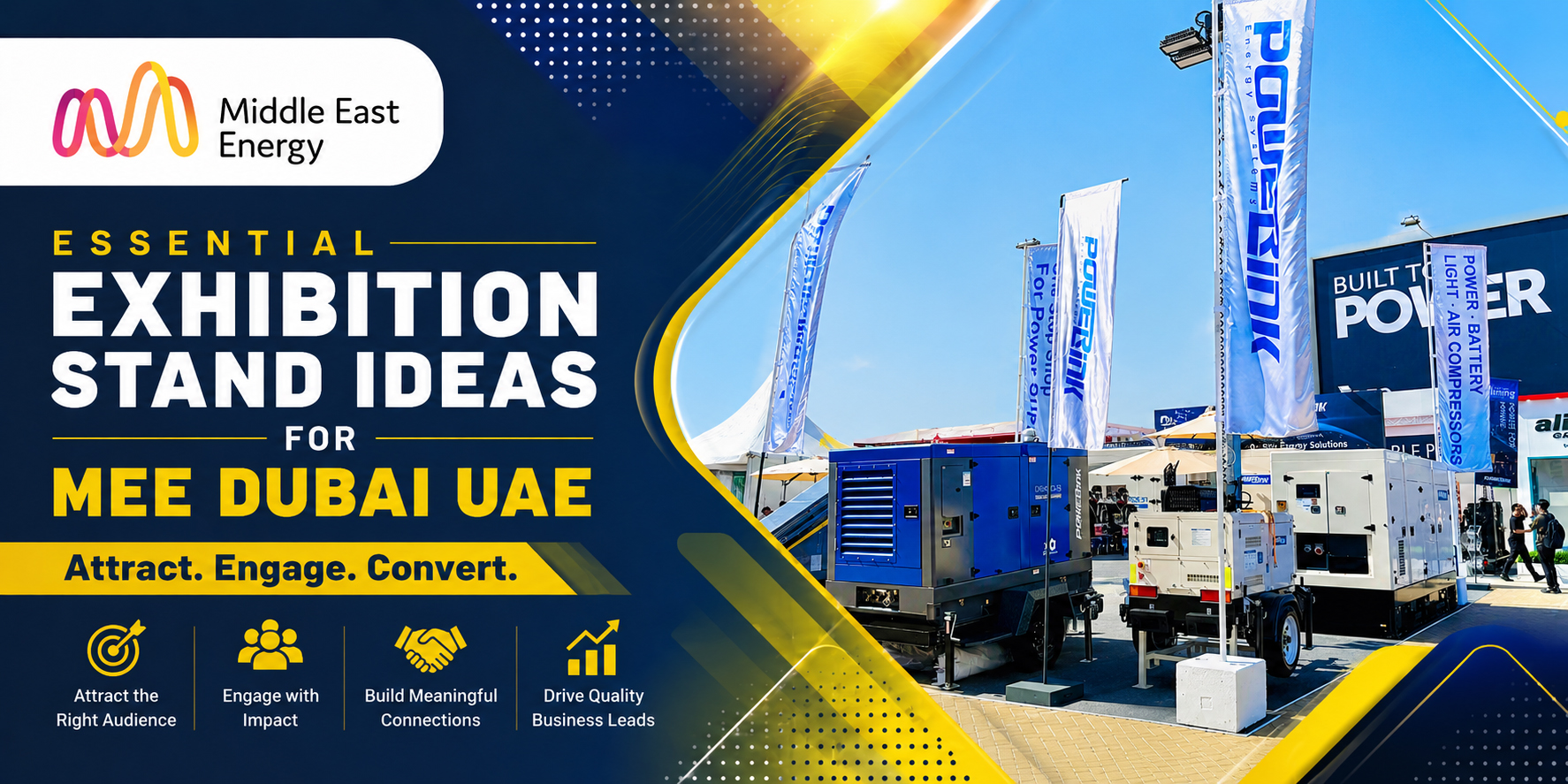
MEE Dubai is a major platform for businesses connected with energy, power, electrical systems, renewable solutions, smart technologies, equipment, infrastructure, and industrial innovation. Exhibitors enter this competitive environment with one clear goal: to attract the right visitors, communicate value quickly, and create business opportunities that continue after the exhibition.
A successful stand is not simply a decorated space. It is a physical marketing environment that represents the brand, explains products, supports conversations, and encourages visitors to take action. Every design decision should have a purpose, from the stand layout and lighting to the graphics, demonstration areas, seating, storage, and digital features.
The following exhibition stand ideas provide a structured approach for planning an effective presence at MEE Dubai UAE.
1. Begin with a Clear Exhibition Objective
The first step is to define what the stand must achieve. Without a clear objective, even an attractive stand can fail to deliver useful results.
Your primary objective may be to generate qualified leads, launch a product, meet distributors, strengthen market awareness, demonstrate equipment, build partnerships, or reconnect with existing clients. Select one main objective and support it with two or three secondary goals.
For example, a company introducing a new energy management solution may focus on product demonstrations as the main objective. Lead collection, media engagement, and distributor meetings can become supporting goals. This clarity helps the design team decide how much space should be allocated to demonstrations, private discussions, branding, and visitor interaction.
Set measurable targets before the design process begins. These may include the number of qualified leads, product demonstrations, scheduled meetings, scanned contacts, partnership discussions, or follow-up requests. A measurable objective turns the stand from a display area into a business tool.
2. Create a Strong Visual Identity
Visitors often decide within a few seconds whether a stand is relevant to them. The visual identity must therefore be clear, confident, and easy to understand from a distance.
Use the company logo in a prominent position, preferably at a height that remains visible across busy aisles. Apply brand colours consistently across walls, counters, digital screens, furniture, and printed materials. The result should feel coordinated rather than overloaded.
Large-format graphics should communicate one primary message. Avoid filling every wall with technical details. A short headline, a strong product image, and a clear benefit are more effective than several paragraphs of text.
For an energy or industrial brand, visual design can communicate reliability, engineering capability, innovation, sustainability, or technical leadership. The design style should match the market position of the company. A premium technology provider may use clean architectural lines and refined lighting, while an equipment manufacturer may choose bold structural elements and visible product displays.
3. Use an Open and Welcoming Layout
An open layout reduces barriers and encourages visitors to enter. High counters, closed walls, and narrow access points can make a stand feel private or difficult to approach.
Keep the main entrance clear and provide more than one access point when the stand location allows it. Place key displays where they can be seen from the aisle without blocking movement. Visitors should understand where to walk, where to stop, and where to speak with the team.
The layout should support a natural visitor journey:
- Attraction from the aisle
- Initial product or brand discovery
- Interaction or demonstration
- Conversation with the sales team
- Lead capture or meeting confirmation
This journey should feel simple and natural. Flooring changes, overhead features, lighting, furniture placement, and display positioning can guide people through the space without the need for signs at every step.
4. Add a High-Impact Product Demonstration Zone
MEE Dubai attracts professionals who want to understand how products and systems perform. A demonstration zone can make complex technology easier to explain and remember.
Design the area around the size and function of the product. Large equipment may require a strong platform, safety clearance, technical connections, and clear viewing angles. Smaller systems can be displayed on illuminated counters, interactive tables, or modular product walls.
Live demonstrations should be short, focused, and repeatable. Explain the problem, show the solution, and highlight the business benefit. Avoid presentations that are too long or too technical for passing visitors.
A screen placed near the demonstration area can support the explanation with diagrams, system data, animations, technical specifications, or real-world applications. The presenter should remain visible and have enough room to communicate without interrupting visitor traffic.
5. Use Digital Technology with a Clear Purpose
Digital features can increase engagement, but they should support the message rather than distract from it. Technology works best when it makes information easier to understand.
Useful digital elements include touchscreens, interactive product selectors, augmented product views, digital catalogues, real-time dashboards, comparison tools, and short explainer videos. A touchscreen can allow visitors to explore solutions based on industry, application, capacity, or technical requirement.
Large LED screens can create visibility, particularly for stands positioned in high-traffic areas. Use short video sequences with strong visuals and limited text. Many visitors may watch without sound, so the message should remain understandable through captions and graphics.
Digital lead forms can also improve data quality. Instead of collecting only names and email addresses, include relevant questions about project stage, product interest, purchasing authority, market, and expected timeline. This information helps the sales team prioritise follow-up activity.
6. Build a Clear Sustainability Story
Sustainability is especially relevant for businesses operating in energy, infrastructure, manufacturing, and technology. The stand itself can support the sustainability message when the materials and communication are planned carefully.
Consider reusable modular structures, recyclable graphics, energy-efficient lighting, rental furniture, digital brochures, and materials that can be repurposed for future exhibitions. Avoid making environmental claims that the stand cannot support.
A dedicated sustainability panel can explain measurable actions, such as energy reduction, waste management, product efficiency, responsible sourcing, or lifecycle performance. Use clear facts and visual comparisons rather than broad statements.
The stand design can also reflect sustainability through natural textures, controlled use of greenery, efficient lighting, and clean material choices. These elements should remain consistent with the brand and should not appear as decoration without meaning.
7. Design Strong Overhead Branding
Overhead branding can improve visibility across a crowded exhibition hall. Suspended signs, illuminated logos, architectural frames, and elevated graphic bands help visitors locate the stand from different directions.
The overhead feature should be readable and structurally balanced. Keep the message simple because visitors may view it from a distance. A logo and a short value statement are usually enough.
The shape can also make the stand more memorable. Circular frames, angled structures, layered lighting, and geometric forms can create a recognisable landmark. However, the feature should connect visually with the rest of the stand rather than appearing as a separate element.
Structural planning, weight limits, installation rules, and technical approvals must be considered early. A professional team can coordinate the creative concept with engineering and operational requirements.
8. Provide Spaces for Different Types of Conversation
Not every visitor interaction requires the same environment. A stand should offer different spaces for quick questions, detailed discussions, and confidential meetings.
Use open counters for short introductions and lead qualification. Add semi-private seating for product discussions or distributor conversations. For senior meetings, commercial negotiations, or technical consultations, include an enclosed meeting room when space permits.
Comfort is important, but the furniture should not dominate the stand. Select chairs and tables that fit the scale of the area and allow staff to move easily. Provide charging access where possible, especially in meeting spaces.
Acoustic control may also be necessary. Fabric panels, enclosed ceilings, soft furniture, and strategic wall placement can reduce noise. A quieter meeting environment helps the team communicate clearly and gives important visitors a more professional experience.
9. Create an Interactive Feature That Visitors Remember
A memorable interaction can increase dwell time and support brand recall. The best interactive ideas are connected with the product, service, or brand message.
An energy company could use a live efficiency challenge, an interactive grid model, a digital power management simulation, or a product configuration tool. A technology supplier could allow visitors to explore system performance through a touchscreen dashboard. A manufacturer could display a transparent product model showing internal components and operation.
Games and competitions can attract attention, but they should also qualify the audience. A simple technical quiz, solution-matching activity, or industry knowledge challenge can be more relevant than a general entertainment feature.
Keep participation easy. Visitors should understand the activity quickly, complete it within a few minutes, and receive a useful result, insight, or reward.
10. Use Lighting to Direct Attention
Lighting influences visibility, mood, product presentation, and perceived quality. A well-lit stand feels open and professional, while poor lighting can make even strong graphics look weak.
Use general lighting for comfortable movement, accent lighting for products, and focused lighting for key messages. Backlit graphics can improve readability and create a premium appearance. Integrated LED lines can highlight architectural shapes and guide visitors through the stand.
Colour temperature should remain consistent. Products with detailed surfaces may need neutral lighting for accurate presentation. Digital screens should be positioned to reduce glare.
Do not light every area with the same intensity. Contrast helps direct attention. The brightest area should usually contain the most important product, message, or activity.
11. Plan Practical Storage and Staff Areas
Operational details have a direct effect on visitor experience. Bags, packaging, personal items, spare brochures, refreshments, cables, and cleaning materials should remain out of sight.
Include lockable storage within counters, wall units, or a dedicated back area. Provide enough space for staff belongings and exhibition supplies. A small preparation area can support refreshments and keep the front of the stand organised.
Staff also need a place for short breaks, particularly during a busy exhibition day. When the stand team remains comfortable and prepared, they communicate with more energy and professionalism.
Technical access should be planned for screens, lighting, internet connections, product equipment, and charging points. Cables should be hidden and safely managed. Maintenance access must remain available throughout the exhibition.
12. Develop a Simple Lead Capture Process
A stand can attract strong traffic and still produce weak results if lead capture is inconsistent. Create a simple process that every team member understands.
Decide what information must be collected and how the lead will be classified. Useful categories may include hot opportunity, future project, distributor enquiry, technical request, existing client, media contact, or general interest.
Digital scanning and forms can reduce manual work, but staff should add meaningful notes after each conversation. Record the visitor requirement, relevant product, decision timeline, next action, and responsible team member.
Before the exhibition, prepare follow-up email templates and assign ownership. High-priority leads should receive personalised communication quickly. General contacts can enter a structured follow-up sequence with product information, case studies, or meeting options.
13. Train the Stand Team Before the Exhibition
The stand team brings the design to life. Even the most impressive environment cannot perform well if staff members are distracted, passive, or unclear about the message.
Conduct a briefing that covers objectives, target visitors, key products, qualifying questions, demonstration schedules, lead capture, meeting procedures, and follow-up responsibilities.
Staff should avoid sitting for long periods, using personal phones in public areas, or forming closed groups. They should remain approachable and position themselves where they can welcome visitors without blocking the entrance.
Prepare a short introduction that explains who the company helps, what it provides, and why it is relevant. The message should be natural rather than memorised. Team members should also know when to involve a technical specialist, sales leader, or senior representative.
14. Work with an Experienced Stand Design Partner
An experienced exhibition partner can turn business objectives into a practical and visually effective stand. The partner should understand concept development, space planning, production, technical coordination, installation, dismantling, and on-site support.
When selecting a Custom Exhibition Stand Design Company in Dubai, review its portfolio, production capability, project management process, material quality, safety approach, and understanding of industry-specific exhibition requirements.
A reliable Custom Exhibition Stand Design Contractor in Dubai should also provide transparent communication, realistic timelines, detailed drawings, technical support, and clear responsibility throughout the project.
Share the brief early and include the stand size, business goals, target audience, products, required facilities, preferred style, technology needs, meeting requirements, storage needs, and budget range. A detailed brief reduces revisions and helps the design team propose solutions that are both creative and practical.
15. Review the Design from the Visitor Perspective
Before approving the final concept, review every element from the visitor point of view.
Can the company name be seen from the main approach? Is the main message understandable within a few seconds? Are the products easy to identify? Does the entrance feel open? Is there enough room around demonstrations? Can visitors find a staff member easily? Are meeting spaces comfortable? Is lead capture simple?
Also review the stand from the staff perspective. Confirm storage, power access, product handling, internet requirements, screen control, cleaning access, refreshments, and security.
A final review should connect every design element with the original objective. Remove anything that adds cost or complexity without improving visibility, communication, engagement, or business results.
An effective stand at MEE Dubai UAE combines strategy, creativity, communication, and practical planning. The strongest concepts are not always the largest or most complicated. They are the stands that make the brand easy to recognise, the solution easy to understand, and the next step easy to take.
Begin with a clear objective, create a strong visual identity, plan an open visitor journey, demonstrate products effectively, use technology with purpose, and prepare the team for meaningful conversations. Support these ideas with practical storage, comfortable meeting areas, focused lighting, and a reliable lead management process. When all elements work together, the stand becomes more than an exhibition structure. It becomes a professional environment for discovery, trust, engagement, and business growth.
Build Your MEE Dubai UAE Presence with Strokes Exhibits Dubai

Create a stand that represents your expertise, attracts qualified visitors, and supports measurable exhibition goals. Partner with an experienced team that can manage creative design, production, installation, project coordination, and on-site execution with professional attention to detail.
Contact the team today to discuss your MEE stand requirements and begin planning a distinctive exhibition presence in Dubai UAE.
FAQs
Find Quick Answers to Your Queries
Get Your Custom Stand Quote Now!
Start with a Free Stand Quote! Transform Your Space with Us


