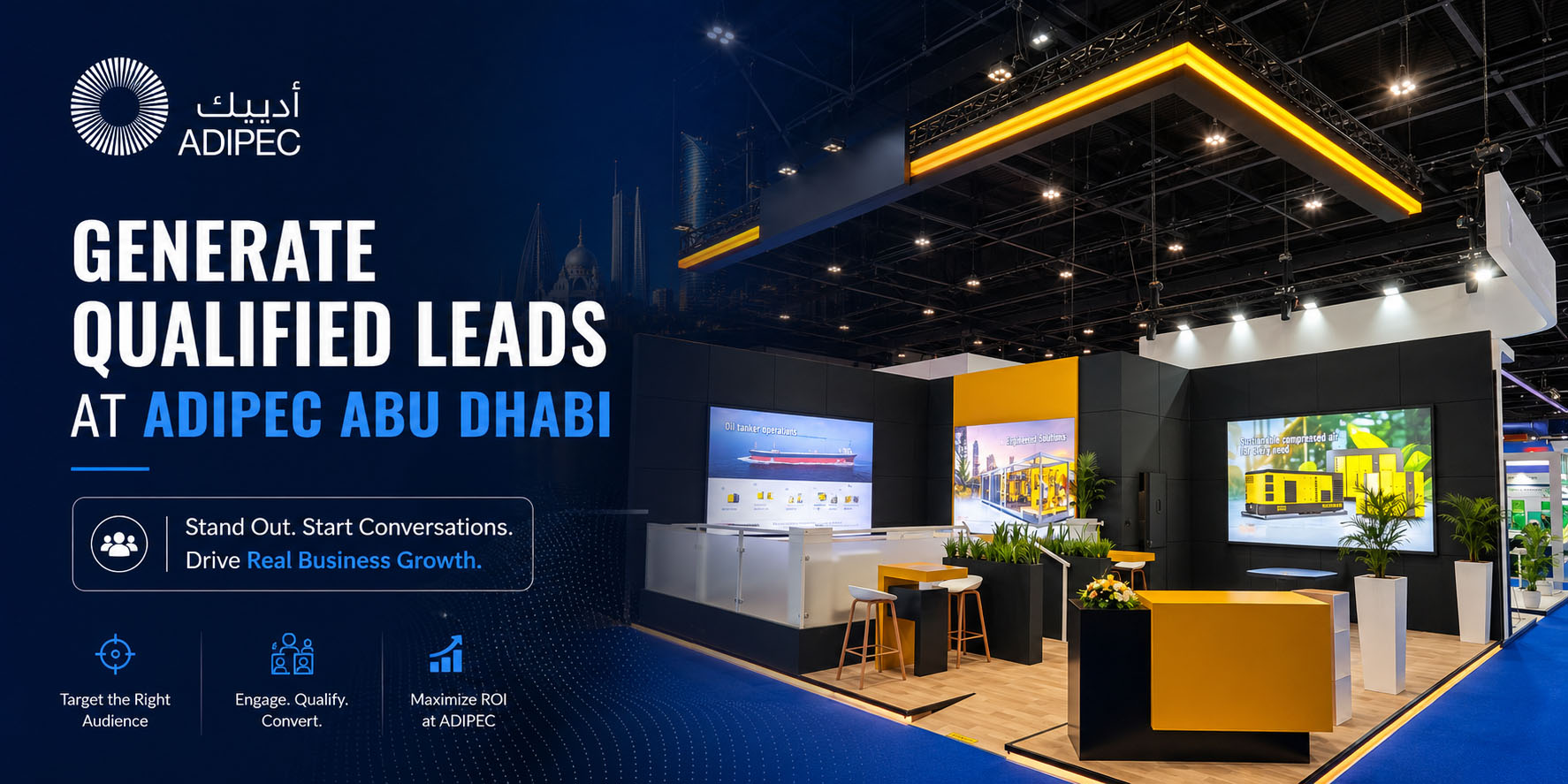
ADIPEC Abu Dhabi attracts decision makers, industry leaders, technical experts, investors, suppliers, and energy professionals from across the world. For exhibiting companies, this creates a valuable opportunity to meet potential clients, strengthen market visibility, and build relationships with influential stakeholders.
However, simply booking exhibition space does not guarantee meaningful business results. The quality of the stand, the clarity of the message, and the effectiveness of the visitor experience determine whether an exhibitor attracts casual footfall or qualified leads.
A custom exhibition stand can help a brand create a professional presence that supports focused conversations and measurable lead generation. It allows the company to present its solutions in a clear, engaging, and relevant manner while guiding visitors through a planned journey.
From the first visual impression to the final follow-up, every element of the stand can contribute to lead quality. The following step by step guide explains how exhibitors can use a custom stand to attract the right audience, start stronger conversations, collect valuable information, and convert exhibition interactions into future business opportunities.
1. Define What a Qualified Lead Means for Your Business
Before planning the stand, the exhibition team should define the type of visitor it wants to attract. A qualified lead is not simply a person who enters the booth or collects a brochure. It is someone who has a relevant requirement, suitable authority, realistic budget, defined project interest, or potential influence over a future purchasing decision.
The qualification criteria may include:
- Industry segment
- Company size
- Job title and decision-making authority
- Current operational challenge
- Project timeline
- Budget range
- Geographic market
- Interest in a specific product or service
- Readiness for a technical discussion
- Potential requirement for a commercial proposal
This information helps the design, sales, and marketing teams work toward the same goal. Once the ideal lead profile is clear, the stand can be developed to attract and engage those visitors instead of trying to appeal equally to everyone.
For example, a company targeting senior procurement professionals may require private meeting rooms and detailed commercial presentations. A technology provider targeting engineers may need demonstration zones, technical screens, and product comparison tools.
Defining the target lead is the first step toward creating a stand that supports measurable business objectives.
2. Build the Stand Around a Clear Lead Generation Strategy
A successful exhibition stand should not be treated only as a decorative structure. It should be planned as a business environment with a clear purpose. Every zone, graphic, demonstration, screen, counter, and meeting area should support a defined stage of the visitor journey.
A practical lead generation strategy can be divided into five stages:
- Attract the right visitors.
- Communicate the main value proposition.
- Encourage relevant interaction.
- Qualify the visitor through conversation.
- Capture information for structured follow-up.
The stand design should make these stages feel natural. Visitors should be able to understand the brand quickly, identify the solutions being presented, and know where to go for more information.
A well-planned layout also helps the exhibition team manage multiple conversations without creating congestion or confusion. Visitors who want a quick introduction should not interfere with scheduled meetings or technical demonstrations.
When the stand is designed around lead generation, every square metre has a clear role in supporting the commercial objective.
3. Use Strong Visual Communication to Attract the Right Audience
At a major industry exhibition, visitors are exposed to hundreds of brands, messages, products, and visual displays. The stand has only a few seconds to communicate relevance.
Large graphics may gain attention, but attention alone is not enough. The message must help the right visitor understand why the stand is worth entering.
The primary message should answer three important questions:
- Who does the company serve?
- What challenge does the company solve?
- What result can the visitor expect?
The headline should be visible from the main aisle and written in simple language. Technical information can be introduced inside the stand, but the first message should be easy to understand.
Supporting graphics can highlight key capabilities, project outcomes, applications, industries served, or areas of expertise. The information should be organised according to importance rather than placing every service and achievement on the main wall.
A Custom Exhibition Stand Design Company in Abu Dhabi can help translate complex offerings into a focused visual experience that communicates value without overwhelming the audience.
Good visual communication does not attempt to explain everything immediately. Its purpose is to attract relevant visitors and encourage them to begin a conversation.
4. Design a Visitor Journey That Supports Better Conversations
A custom stand gives exhibitors greater control over how visitors enter, explore, interact, and meet the team. This control is important because the physical journey can influence the quality of the conversation.
The front of the stand should be open, visible, and welcoming. It can include a clear brand introduction, product display, interactive screen, or short demonstration.
The central area can provide more detailed information for visitors who show genuine interest. Private or semi-private meeting spaces can support discussions involving commercial details, technical requirements, partnerships, or confidential projects.
The journey should not force every visitor into the same experience. Some visitors may want a quick overview, while others may need a technical presentation or scheduled meeting. A flexible design allows the exhibition team to manage different visitor needs efficiently.
Clear zoning can also help staff identify visitor intent. A person studying a technical display may require a product specialist. A visitor approaching the meeting area may already have a defined business objective.
The layout should make it easy for staff to recognise these signals and respond appropriately.
5. Present Solutions Instead of Listing Features
Many exhibitors fill their stands with product features, company history, certifications, and technical specifications. These details can be useful, but they do not always answer the visitor’s most important question.
The visitor wants to know how the solution can help the organisation.
A stronger content approach connects product features to practical outcomes. Instead of only describing what a product does, explain how it can:
- Improve operational efficiency
- Reduce operational risk
- Support sustainability objectives
- Increase equipment reliability
- Lower long-term costs
- Improve workplace safety
- Simplify maintenance
- Solve a specific industry problem
Technical information should be presented within a meaningful business context.
For example, a product or service can be explained through the following structure:
- Identify the challenge faced by the customer.
- Present the solution provided by the company.
- Explain the practical benefit.
- Provide evidence or proof.
- Suggest the next step for interested visitors.
This structure helps visitors connect the offering with their own requirements. It also gives stand staff a clear framework for beginning relevant conversations.
6. Create Interactive Experiences That Reveal Visitor Interest
Interactive content can do more than entertain visitors. It can help exhibitors identify visitor interests, business challenges, and potential purchase intent.
The key is to connect each interactive feature with the lead qualification process.
Useful interactive options may include:
- Product demonstrations
- Digital solution selectors
- Touchscreen case studies
- Technical simulations
- Industry-specific presentations
- Data visualisations
- Equipment models
- Augmented reality experiences
- Short expert sessions
- Live problem-solving demonstrations
Each interaction should lead to a relevant question.
For example, after a visitor explores a digital product selector, a team member can ask which application is most relevant to the visitor’s organisation. After a demonstration, the staff member can ask whether the visitor is currently evaluating a similar solution.
The answers help the team understand whether the visitor has general curiosity or a genuine commercial requirement.
Interactive experiences are most effective when they provide useful information while helping the team start a focused conversation.
7. Train Stand Staff to Qualify Leads Professionally
The stand may attract the right visitors, but trained staff are responsible for converting visitor interest into qualified opportunities.
Team members should know how to welcome visitors, identify their needs, explain solutions clearly, and record important information.
A simple qualification conversation can follow these steps:
- Welcome the visitor and introduce the company briefly.
- Ask what brought the visitor to the stand.
- Identify the visitor’s role and organisation.
- Ask about current challenges or future projects.
- Present the most relevant solution.
- Confirm the visitor’s level of interest.
- Agree on the next step.
- Record accurate notes immediately.
Staff should avoid delivering the same long sales presentation to every visitor. The conversation should be based on the visitor’s needs, level of knowledge, and position in the buying process.
Open questions are especially useful because they encourage the visitor to share valuable context.
Examples include:
- What are your main priorities in this area?
- Which operational challenge are you currently trying to solve?
- Are you evaluating solutions for an active project?
- Who else is involved in the decision-making process?
- What project timeline are you working toward?
- What information would help you move forward?
Professional qualification makes the conversation more valuable for both the exhibitor and the visitor.
8. Use Technology to Capture Accurate Lead Information
Paper forms and unstructured business card collection can create problems after the exhibition. Information may be incomplete, difficult to read, or disconnected from the original conversation.
A digital lead capture system allows the team to collect consistent data and record specific follow-up requirements.
The lead form should include essential information such as:
- Name
- Company
- Position
- Contact details
- Area of interest
- Project status
- Expected timeline
- Budget indication, where appropriate
- Decision-making role
- Agreed next action
- Conversation notes
- Lead priority
The form should be quick and easy to complete. Too many fields may slow down the team and frustrate visitors.
Exhibitors can use conditional questions so that additional fields appear only when they are relevant. For example, detailed project questions may appear only when the visitor confirms that there is an active requirement.
It is also important to follow applicable privacy and consent requirements. Visitors should understand how their information will be stored and used, especially when they are subscribing to future communications.
9. Add Meeting Spaces That Support High-Value Discussions
Qualified leads often need more than a quick conversation at the edge of the stand. Senior decision makers, procurement teams, technical specialists, and potential partners may require a quieter environment where they can discuss business objectives in detail.
A custom stand can include different meeting formats:
- Open discussion tables for short conversations
- Semi-private seating for focused consultations
- Enclosed rooms for confidential meetings
- Presentation areas for small groups
- Hospitality spaces for relationship building
The number and type of meeting spaces should be based on expected visitor traffic, the sales process, and the importance of pre-booked appointments.
Good acoustic control, comfortable seating, proper lighting, and access to presentation equipment can improve the quality of the discussion.
A Custom Exhibition Stand Design Contractor in Abu Dhabi should also consider operational details such as staff movement, storage access, refreshments, cable management, presentation technology, and the transition between public and private areas.
These practical details help the team conduct professional meetings without unnecessary interruptions.
10. Support Lead Generation with Pre-Event Promotion
Lead generation begins before visitors arrive at the exhibition. The stand becomes more effective when it is supported by a targeted promotional campaign.
Exhibitors can invite existing clients, prospects, partners, distributors, consultants, and industry contacts to visit the stand. The invitation should provide a clear and valuable reason to attend.
Possible reasons may include:
- A new product launch
- A live demonstration
- A technical consultation
- A meeting with company leadership
- An expert presentation
- A confidential project discussion
- A partnership opportunity
- Access to new research or industry insights
Pre-booked meetings are especially valuable because they create a predictable flow of high-priority visitors.
The stand design should reserve suitable space and time for these meetings without reducing accessibility for general visitors.
Marketing communications should use a consistent message across email campaigns, social media, sales outreach, advertising, appointment booking pages, and promotional materials. This consistency helps visitors recognise the brand and understand its exhibition objective.
11. Create a Lead Scoring System Before the Exhibition
Not every lead has the same value or urgency. A scoring system helps the team prioritise follow-up and allocate sales resources effectively.
A simple scoring model can classify leads into four groups.
High-Priority Lead: The visitor has a defined requirement, suitable decision-making authority, an active project timeline, and strong interest in a relevant solution.
Medium-Priority Lead: The visitor has potential interest but requires more information, internal discussion, budget approval, or a longer project timeline.
Long-Term Opportunity: The visitor may not have an immediate project but has strategic relevance, partnership potential, or future purchasing influence.
General Contact:
The visitor has limited immediate commercial relevance but may be suitable for newsletters, educational content, brand communication, or broader industry networking.
The qualification criteria should be agreed upon before the exhibition so that all team members classify leads consistently.
The lead score should be recorded during or immediately after each conversation. Waiting until the end of the day can result in incomplete information and inaccurate classifications.
12. Give Every Qualified Visitor a Clear Next Step
A good exhibition conversation should end with a specific action. Vague promises to stay in touch often lead to weak or delayed follow-up.
The next step should match the visitor’s level of interest and current position in the buying process.
Possible next actions include:
- Scheduling a technical consultation
- Arranging a product demonstration
- Sending a commercial proposal
- Sharing a relevant case study
- Providing pricing information
- Organising a site visit
- Introducing a regional specialist
- Planning a meeting with senior management
- Starting a pilot project discussion
- Reviewing technical specifications
The staff member should confirm who is responsible for the next action, what information will be provided, and when the next contact will take place.
This creates accountability and gives the visitor confidence that the conversation will continue productively.
Where possible, the next meeting can be scheduled before the visitor leaves the stand. This reduces delays and creates a stronger commitment from both parties.
13. Follow Up Quickly and Personally
The value of a qualified lead can decline when follow-up is delayed. Visitors attend many meetings and may speak with several competing suppliers during the exhibition.
A timely and personalised response helps the exhibitor remain relevant.
The follow-up message should refer to the actual conversation instead of only thanking the visitor for attending. It should include:
- The challenge or topic discussed
- The most relevant solution
- Any promised document or information
- The agreed next step
- A clear contact person
- A proposed date for further discussion
High-priority leads should receive immediate attention from the appropriate sales or technical representative.
Medium-priority leads can enter a structured nurturing process with relevant case studies, technical articles, product information, or invitations to future discussions.
Long-term opportunities should be recorded in the customer relationship management system with reminders for future engagement.
The lead data should also be reviewed for completeness. Missing notes, unclear ownership, and duplicate records should be corrected before the team begins broader follow-up.
14. Measure Performance Beyond Visitor Numbers
A busy stand may look successful, but visitor volume does not always reflect commercial value.
Exhibitors should evaluate performance using metrics connected to business objectives.
Useful measurements include:
- Total number of qualified leads
- Number of high-priority opportunities
- Number of pre-booked meetings completed
- Lead-to-meeting conversion rate
- Meeting-to-proposal conversion rate
- Estimated sales pipeline value
- Cost per qualified lead
- Follow-up completion rate
- Number of technical consultations requested
- Number of partnership discussions
- Revenue influenced by exhibition leads
The team should also review qualitative feedback.
Which message attracted the strongest interest? Which demonstration started the best conversations? Which stand area was underused? What questions did visitors ask repeatedly? Which products or services received the highest level of attention?
These insights can improve future marketing campaigns, sales materials, product communication, exhibition planning, and customer engagement strategies.
15. Align Design, Content, People, and Follow-Up
Qualified lead generation is strongest when every element of the exhibition strategy works together.
A visually impressive stand cannot compensate for unclear messaging. Strong sales staff cannot perform efficiently in a poorly planned layout. A successful meeting can lose its value when the follow-up process is weak.
The exhibition strategy should align four core areas.
Design: The stand should attract the right audience, support visitor movement, provide suitable engagement zones, and create a professional environment for conversations.
Content: The messaging should explain relevant problems, solutions, outcomes, and supporting evidence in a clear and structured manner.
People: The team should be trained, properly briefed, approachable, and capable of qualifying different types of visitors.
Process: Lead capture, scoring, ownership, follow-up, reporting, and performance measurement should be defined before the exhibition begins.
When these areas are aligned, the stand becomes more than a branded space. It becomes a practical lead generation platform that helps the company identify opportunities, deepen professional relationships, and create measurable business value.
Generating qualified leads at ADIPEC Abu Dhabi requires a planned and structured approach. The exhibitor must understand its target audience, communicate a clear value proposition, create relevant visitor experiences, train the stand team, capture accurate information, and follow up with purpose.
A custom exhibition stand supports this process by creating an environment designed around the business objective. It can attract the right visitors, simplify complex information, encourage meaningful interaction, and provide the spaces needed for technical and commercial discussions.
The most effective exhibitors do not focus only on increasing footfall. They focus on improving visitor relevance, conversation quality, lead accuracy, and next-step commitment.
With the right strategy, design, content, people, and follow-up system, an exhibition stand can generate valuable opportunities that continue well beyond the event.
Build a Lead-Generating Exhibition Stand with Strokes Exhibits Abu Dhabi
Make your presence at ADIPEC more purposeful with a custom exhibition stand designed to attract decision makers, encourage valuable conversations, and generate qualified business leads. Work with the best exhibition stand design contractor in Abu Dhabi UAE to create an engaging brand environment that supports your marketing goals and delivers a professional visitor experience.
Contact Strokes Exhibits today to discuss your exhibition requirements and begin creating a custom stand that turns visitor interest into measurable business opportunities.
FAQs
Find Quick Answers to Your Queries
Get Your Custom Stand Quote Now!
Start with a Free Stand Quote! Transform Your Space with Us


